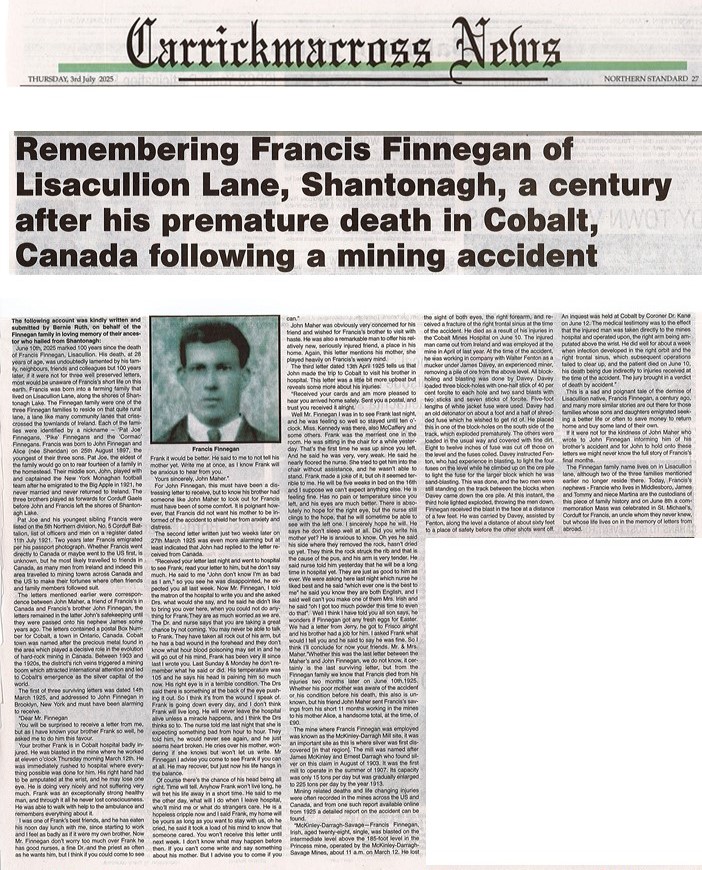
This article featured in the Northern Standard Newspaper dated 03.07.2025
June 10th, 2025 marked 100 years since the death of Francis Finnegan, Lisacullion. His death, at 28 years of age, was undoubtedly lamented by his family, neighbours, friends and colleagues but 100 years later, if it were not for three well preserved letters, most would be unaware of Francis’s short life on this earth. Francis was born into a farming family that lived on Lisacullion lane, along the shores of Shantonagh Lake. The Finnegan family were one of the three Finnegan families to reside on that quite rural lane, a lane like many community lanes that crisscrossed the townlands of Ireland. Each of the families were identified by a nickname – ‘Pat Joe’ Finnegan’s, ‘Pike’ Finnegan’s and the ‘Cormac’ Finnegan’s. Francis was born to John Finnegan and Alice née Sheridan on 25th August 1897, the youngest of their three sons. Pat Joe the eldest of the family would go on to rear fourteen of a family in the homestead. Their middle son, John, played with and captained the New York Monaghan football team after he emigrated to the big apple in 1921, he never married and never returned to Ireland. The three brothers played as forwards for Corduff Gaels before John & Francis left the shores of Shantonagh Lake.
Pat Joe and his youngest sibling Francis were listed on the “5th Northern division, No. 5 Corduff Battalion, list of officers and men on a register dated 11th July, 1921.” Two years later Francis emigrated per his passport photograph. Whether Francis went directly to Canada or maybe went to the US first, is unknown, but he most likely travelled to friends in Canada as many men from Ireland and indeed this area travelled to mining towns across Canada and the U.S. to make their fortunes where often friends and family members followed suit.
The letters mentioned earlier were correspondence between John Maher, a friend of Francis’s in Canada and Francis’s brother John Finnegan, the letters remained in the latter John’s safekeeping until they were passed onto his nephew James some years ago. The letters contained a postal Box Number for Cobalt, a town in Ontario, Canada. Cobalt town, was named after the precious metal found in the area which “played a decisive role in the evolution of hard-rock mining in Canada. Between 1903 and the 1920s, the district’s rich veins triggered a mining boom which attracted international attention and led to Cobalt’s emergence as the silver capital of the world.”
The first of three surviving letters was dated 14th March 1925, and addressed to John Finnegan in Brooklyn, New York and must have been alarming to receive.
“Dear Mr. Finnegan
You will be surprised to receive a letter from me, but as I have known your brother Frank so well, he asked me to do him this favour.
Your brother Frank is in Cobalt hospital badly injured. He was blasted in the mine where he worked at eleven o’clock Thursday morning March 12th. He was immediately rushed to hospital where everything possible was done for him. His right hand had to be amputated at the wrist, and he may lose one eye. He is doing very nicely and not suffering very much. Frank was an exceptionally strong healthy man, and through it all he never lost consciousness. He was able to walk with help to the ambulance, and remembers everything about it.
I was one of Frank’s best friends, and he has eaten his noon day lunch with me, since starting to work and I feel as badly as if it were my own brother. Now Mr. Finnegan don’t worry too much over Frank he has good nurses, a fine Dr and the priest as often as he wants him, but I think if you could come to see Frank it would be better. He said to me to not tell his mother yet. Write me at once, as I know Frank will be anxious to hear from you.
Yours sincerely, John Maher.”
For John Finnegan, this must have been a distressing letter to receive, but to know his brother had someone like John Maher to look out for Francis must have been of some comfort. It is poignant however, that Francis did not want his mother to be informed of the accident to shield her from anxiety and distress.
The second letter written just two weeks later on 27th March 1925 was even more alarming, but at least indicated that John had replied to the letter received from Canada.
“Received your letter last night and went to hospital to see Frank, read your letter to him, but he don’t say much. He said to me “John don’t know I’m as bad as I am,” so you see he was disappointed, he expected you all last week. Now Mr. Finnegan, I told the matron of the hospital to write you and she asked Drs. what would she say, and he said he didn’t like to bring you over here, when you could not do anything for Frank.
They are as much worried as we are. The Dr and nurse says that you are taking a great chance by not coming. You may never be able to talk to Frank. They have taken all rock out of his arm, but he has a bad wound in the forehead and they don’t know what hour blood poisoning may set in and he will go out of his mind. Frank has been very ill since last I wrote you. Last Sunday & Monday he don’t remember what he said or did. His temperature was 105 and he says his head is paining him so much now. His right eye is in a terrible condition. The Drs said there is something at the back of the eye pushing it out. So I think it’s from the wound I speak of. Frank is going down every day, and I don’t think Frank will live long. He will never leave the hospital alive unless a miracle happens, and I think the Drs thinks so to. The nurse told me last night that she is expecting something bad from hour to hour. They told him, he would never see again, and he just seems heart broken. He cries over his mother, wondering if she knows but won’t let us write. Mr Finnegan I advise you come to see Frank if you can at all. He may recover, but just now his life hangs in the balance.
Of course there’s the chance of his head being all right. Time will tell. Anyhow Frank won’t live long, he will fret his life away in a short time. He said to me the other day, what will I do when I leave hospital, who’ll mind me or what do strangers care. He is a hopeless cripple now and I said Frank, my home will be yours as long as you want to stay with us, oh he cried, he said it took a load of his mind to know that someone cared. You won’t receive this letter until next week. I don’t know what may happen before then. If you can’t come write and say something about his mother. But I advise you to come if you can.”
John Maher was obviously very concerned for his friend and wished for Francis’s brother to visit with haste. He was also a remarkable man to offer his relatively new, seriously injured friend, a place in his home. Again, this letter mentions his mother, she played heavily on Francis’s weary mind.
The third letter dated 13th April 1925 tells us that John made the trip to Cobalt to visit his brother in hospital. This letter was a little bit more upbeat but reveals some more about his injuries.
“Received your cards and am more pleased to hear you arrived home safely. Sent you a postal, and trust you received it alright. Well Mr. Finnegan I was in to see Frank last night, and he was feeling so well so stayed until ten o’clock. Miss. Kennedy was there, also McCaffery and some others. Frank was the merriest one in the room. He was sitting in the chair for a while yesterday. That’s the first time he was up since you left. And he said he was very very weak. He said he nearly floored the nurse. She tried to get him into the chair without assistance, and he wasn’t able to stand. Frank made a joke of it, but oh it seemed terrible to me. He will be five weeks in bed on the 16th and I suppose we can’t expect anything else. He is feeling fine. Has no pain or temperature since you left, and his eyes are much better. There is absolutely no hope for the right eye, but the nurse still clings to the hope, that he will sometime be able to see with the left one. I sincerely hope he will. He says he don’t sleep well at all. Did you write his mother yet? He is anxious to know. Oh yes he said his side where they removed the rock, hasn’t dried up yet. They think the rock stuck the rib and that is the cause of the pus, and his arm is very tender. He said nurse told him yesterday that he will be a long time in hospital yet. They are just as good to him as ever. We were asking here last night which nurse he liked best and he said “which ever one is the best to me” he said you know they are both English, and I said well can’t you make one of them Mrs. Irish and he said “oh I got too much powder this time to even do that”. Well I think I have told you all son says, he wonders if Finnegan got any fresh eggs for Easter. We had a letter from Jerry, he got to Frisco alright and his brother had a job for him. I asked Frank what would I tell you and he said to say he was fine. So I think I’ll conclude for now your friends. Mr. & Mrs. Maher.”
Whether this was the last letter between the Maher’s and John Finnegan, we do not know, it certainly is the last surviving letter, but from the Finnegan family we know that Francis died from his injuries two months later on June 10th,1925. Whether his poor mother was aware of the accident or his condition before his death, this also is unknown, but his friend John Maher sent Francis’s savings from his short 11 months working in the mines to his mother Alice, a handsome total, at the time, of £90.
The mine where Francis Finnegan was employed was known as the McKinley-Darragh Mill site, it was “an important site as this is where silver was first discovered [in that region]. The mill was named after James McKinley and Ernest Darragh who found silver on this claim in August of 1903. It was the first mill to operate in the summer of 1907. Its capacity was only 15 tons per day but was gradually enlarged to 225 tons per day by the year 1913.”
Mining related deaths and life changing injuries were often recorded in the mines across the U.S. and Canada, and from one such report available online from 1925 a detailed report on the accident can be found.
“McKinley-Darragh-Savage—Francis Finnegan, Irish, aged twenty-eight, single, was blasted on the intermediate level above the 185-foot level in the Princess mine, operated by the McKinley-Darragh-Savage Mines, about 11 a.m. on March 12. He lost the sight of both eyes, the right forearm, and received a fracture of the right frontal sinus at the time of the accident. He died as a result of his injuries in the Cobalt Mines Hospital on June 10. The injured man came out from Ireland and was employed at the mine in April of last year. At the time of the accident, he was working in company with Walter Fenton as a mucker under James Davey, an experienced miner, removing a pile of ore from the above level. All block-holing and blasting was done by Davey. Davey loaded three block-holes with one-half stick of 40 per cent forcite to each hole and two sand blasts with two sticks and seven sticks of forcite. Five-foot lengths of white jacket fuse were used. Davey had an old detonator on about a foot and a half of shredded fuse which he wished to get rid of. He placed this in one of the block-holes on the south side of the track, which exploded prematurely. The others were loaded in the usual way and covered with fine dirt. Eight to twelve inches of fuse was cut off those on the level and the fuses coiled. Davey instructed Fenton, who had experience in blasting, to light the four fuses on the level while he climbed up on the ore pile to light the fuse for the larger block which he was sand-blasting. This was done, and the two men were still standing on the track between the blocks when Davey came down the ore pile. At this instant the third hole lighted exploded, throwing the men down. Finnegan received the blast in the face at a distance of a few feet. He was carried by Davey, assisted by Fenton, along the level a distance of about sixty feet to a place of safety before the other shots went off. An inquest was held at Cobalt by Coroner Dr. Kane on June 12. The medical testimony was to the effect that the injured man was taken directly to the mines hospital and operated upon, the right arm being amputated above the wrist. He did well for about a week when infection developed in the right orbit and the right frontal sinus, which subsequent operations failed to clear up, and the patient died on June 10, his death being due indirectly to injuries received at the time of the accident. The jury brought in a verdict of death by accident.”
This is a sad and poignant tale of the demise of Lisacullion native, Francis Finnegan, a century ago, and many more similar stories are out there for those families whose sons and daughters emigrated seeking a better life or often to save money to return home and buy some land of their own.
If it were not for the kindness of John Maher who wrote to John Finnegan informing him of his brother’s accident and for John to hold onto these letters we might never know the full story of Francis’s final months.
The Finnegan family name lives on in Lisacullion lane, although two of the three families mentioned earlier no longer reside there. Today, Francis’s nephews – Francie who lives in Middlesboro, James and Tommy and niece Martina are the custodians of this piece of family history and on June 8th a commemoration Mass was celebrated in St. Michael’s, Corduff for Francis, an uncle whom they never knew, but whose life lives on in the memory of letters from abroad.